
In customer experience, the ability to understand customers has advanced rapidly. Organisations can now track sentiment in real time, anticipate intent and generate insight at scale.
Yet, despite this progress, many still face the same challenge: knowing what customers need does not always translate into meaningful action when it matters most.
In this thought-provoking piece, WiCX Inner Circle member and AI & CX Transformation Leader, Nermien Emad, explores how Agentic AI is beginning to reshape CX leadership itself. Rather than simply supporting human decisions, these systems are beginning to evaluate context, trigger responses, and take direct action across customer journeys in real time.
Drawing on her expertise at the intersection of AI and customer experience, Nermien examines the shift from reactive, human-led models towards proactive systems that can act independently at scale.
She explores the implications this creates for governance, accountability, and trust, while challenging organisations to define where human judgement should remain essential as AI takes on a greater role in decision-making.
The Gap Between Insight and Action
Over the past few years, CX has significantly improved its ability to observe customers. Organisations can track sentiment in real time, follow behaviour across channels, and anticipate intent before it is explicitly expressed. The level of visibility available today would have been difficult to achieve not long ago.
And yet, a gap still shows up consistently in practice. Even in organisations that have invested heavily in CX and built relatively mature data and analytics capabilities, the same pattern appears. They can identify what a customer needs and still fail to act on it at the moment it matters.
The issue is not visibility. It’s what happens after.
In many cases, the system is simply not designed to take action without waiting for a human decision in between.
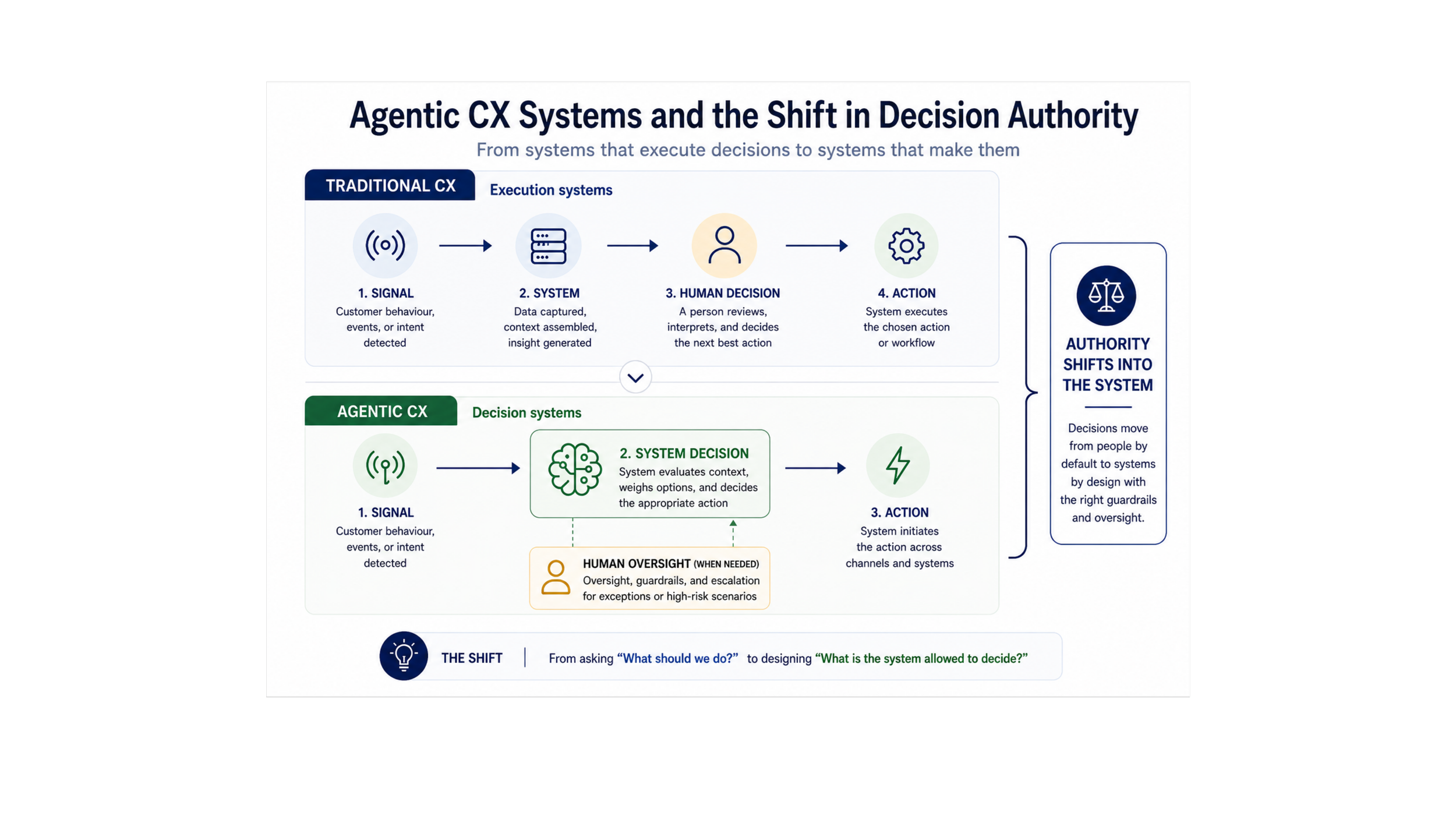
From Execution Systems to Decision Systems
Most of what has been built in CX over the past decade is centred around execution. IVRs route interactions, CRMs store context, and workflows trigger predefined actions based on rules. Even when AI is introduced, it typically supports decision-making, for example, by scoring churn risk or recommending the next-best actions rather than taking ownership of the decision itself.
The underlying pattern has remained stable: humans decide, and systems execute.
That operation model is already beginning to evolve in practice. In many organisations today, AI is introduced through assistive capabilities embedded directly into operational workflows. In contact centres, for example, systems can summarise conversations in real time, surface relevant knowledge articles, identify churn risk, or recommend next-best actions while employees remain responsible for deciding how to respond.
In more advanced environments, parts of that workflow are already starting to move beyond recommendation into supervised execution. For example, a churn-risk signal may automatically trigger a standard retention offer or service recovery action within predefined thresholds, while higher-risk or more sensitive scenarios continue to require approval or escalation.
Agentic AI extends that progression further. The system is no longer limited to supporting human decisions or recommending actions; it begins to evaluate context, determine the appropriate response, and initiate action directly across channels and operational systems in real time.
This is not a fully autonomous shift, but a structural one. The transition is not simply about adding more AI into customer journeys. It is about moving decision-making itself closer to the system layer, changing how responses are triggered, governed, and scaled across the organisation.

“The transition is not simply about adding more AI into customer journeys. It is about moving decision-making itself closer to the system layer, changing how responses are triggered, governed, and scaled across the organisation.”
— Nermien Emad
The Assumption Behind Most CX Systems
Most CX operating models are built on a core assumption: that decision-making sits with a person. Journey design, escalation paths, governance structures, and SLAs all assume that a human receives a signal and determines the appropriate response.
That model has worked, and it is what brought the industry to its current level of maturity. It is also where its limitations begin to show.
Take a churn signal. In a traditional setup, it appears on a dashboard, moves through a workflow, and eventually informs a human response to a call, an offer, or a targeted intervention. The organisation can identify the risk clearly, but action still depends on someone stepping in.
In an agentic setup, that same signal can directly trigger a decision initiating an offer, adjusting the experience, or escalating the case based on context. The difference is not only speed; it is that the system takes responsibility for the response.
Where Leadership Mindset Shifts
This is where the implications become more concrete. Once systems begin to make decisions, the work shifts. It is no longer only about designing journeys or coordinating channels. It becomes about defining what the system is authorised to decide, where it should stop, and when human judgement must be introduced.
This is where most organisations are still not explicit.
These are not technical details. They are decisions about risk, accountability, and the type of experience an organisation is willing to stand behind.
Whether a system can proactively offer compensation, how it handles vulnerable customers, how it prioritises between retention and cost, or how it behaves in regulated scenarios, these are all choices that need to be defined deliberately. If they are not, they become embedded implicitly in rules, models, or engineering decisions.
This also introduces a different type of risk. When decisions move into systems, mistakes no longer happen one interaction at a time. They can scale just as quickly as correct decisions do.
What Systems Start to Reveal
Once systems begin to make decisions, they also start to make organisational priorities visible.
They reflect trade-offs.
If a system consistently resolves issues quickly but does so at the expense of long-term customer value, that reflects a prioritisation. If it escalates aggressively to minimise risk, that reflects another. If it ignores complaint history in favour of immediate resolution speed, that too becomes visible in behaviour.
These choices are not abstract. They are expressed directly in how the system acts, and once embedded, they scale.
This shifts the design work beyond journeys. It becomes about shaping how the organisation behaves across large volumes of interactions without requiring a human decision each time.

“This shifts the design work beyond journeys. It becomes about shaping how the organisation behaves across large volumes of interactions without requiring a human decision each time.”
— Nermien Emad
Visibility Into Decisions, Not Just Outcomes
Another shift is the need for visibility into decisions, not just outcomes. Measuring performance is one thing; understanding why a decision was made is another.
If a system declines a request, offers compensation, or escalates a case, that decision needs to be traceable. What inputs were considered? What logic triggered the action? Under what conditions would the outcome have been different?
Without that level of visibility, governance becomes difficult. This is why auditability, explainability, and clearly defined escalation logic need to be built into the system, not just for compliance, but to ensure decisions can be understood and adjusted over time.
Where Accountability Sits
Accountability also shifts. Traditionally, CX accountability has been managed at runtime through monitoring, coaching, and iterative improvements.
When decisions are embedded within systems, that model becomes less effective.
Accountability moves earlier into how the system is configured, what it is authorised to do, and how it prioritises outcomes. Decision quality is no longer primarily improved after the fact; it is defined upfront.
The Shift Towards Explicit Agentic Decisions
Organisations have spent years building systems that help them understand customers more effectively. Those systems are now beginning to act on that understanding.
That transition changes the role of CX leadership more than it changes the technology itself. It becomes less about managing performance in real time and more about defining authority in advance.
For leaders, this means moving beyond defining journeys and starting to define decision frameworks, what signals matter, what decisions can be automated, and where human judgement remains essential.
At some point, every organisation will need to answer a simple question:
What are we comfortable allowing our systems to decide?
Because whether that decision is made explicitly or not, the system will still make it. The challenge for organisations is no longer only how to introduce AI into customer journeys. It is how to decide where systems should act independently, where human judgement should remain involved, and how those decisions are governed over time.
In practice, that decision will likely depend on factors such as customer impact, regulatory exposure, financial risk, and the organisation’s confidence in how consistently the system can behave under different conditions. The challenge is not simply deciding what can be automated, but what should be trusted to act independently in the first place.

“The challenge for organisations is no longer only how to introduce AI into customer journeys. It is how to decide where systems should act independently, where human judgement should remain involved, and how those decisions are governed over time.”
— Nermien Emad
Keep the Conversation Going
Nermien’s insights highlight that the future of customer experience is no longer just about understanding customers better, but about defining how intelligently, responsibly, and proactively organisations choose to act on those insights.
As Agentic AI continues to reshape decision-making, governance, and accountability in CX, these are conversations that leaders can no longer afford to treat as future thinking.
Inside the WiCX community, we’re creating space for exactly these discussions. From expert-led sessions and member conversations to live events and industry panels, we bring together women leading the future of CX, AI, and transformation to explore the opportunities and challenges shaping the next era of customer experience.
Agentic AI, intelligent systems, and the future of CX leadership will be key themes explored at the WiCX UnConference 2026. If you’d like to be part of the conversation, join the waitlist to be the first to hear the 2026 dates, locations, and ticket access.