
AI in Customer Experience: Why Responsible CX by Design Is Becoming a Leadership Decision
By Clare Muscutt, Founder and CEO, Women in CX

There is a particular kind of conversation that tends to happen when women working in customer experience are given the time and space to speak openly.
The discussion quickly moves beyond tools and technology and into the practical realities of delivering experiences inside organisations — the trade-offs, the pressures and the decisions that rarely make it into strategy decks.
That was exactly the spirit of the first Women in CX International Women’s Day CX Lab, hosted at Kantar’s London HQ. Rather than focusing on the hype surrounding AI, the session brought together women working across customer experience, research, design and technology to explore a more grounded question:
What does responsible AI actually look like inside real organisations?
Joining the panel discussion were four leaders navigating those questions every day:
Sandrea Morgan, Head of Customer Support at Adanola
Ewa Davenport, Senior CX Director at Kantar
Lily McNally, Design Lead at Scottish Widows (Lloyds Banking Group)
Helen Shaffer, tech founder and former design leader at Spotify
As the conversation unfolded, it became clear that the challenge many organisations face today is not simply adopting AI.
It is deciding where it belongs in the experience — and how to introduce it in ways that strengthen rather than weaken the trust customers place in the brands they interact with.
AI Inside Existing Organisations
Outside organisations, AI is often discussed in terms of capability. Inside organisations, the conversation tends to look different.
Ewa Davenport shared research from Kantar suggesting that nearly half of women report concern about the societal impact of AI, and many say they feel overwhelmed by the pace at which it is being introduced.
That reaction is often interpreted as caution. During the discussion, Ewa suggested it can also reflect a different responsibility.
“We often end up acting as the custodians of trust,” she said.
The questions that surface from CX, insight and design teams often revolve around whether the technology is ready for the role it is being given. Is the data reliable? Do customers understand what is happening? Is the system appearing somewhere in the experience where people expect it?
In regulated sectors particularly, those questions carry real weight.
“For example, in financial services you can’t ‘just do AI’,” Ewa said. Decisions about how technology interacts with customers have implications for data protection, regulatory compliance and long-term trust and must be considered carefully.
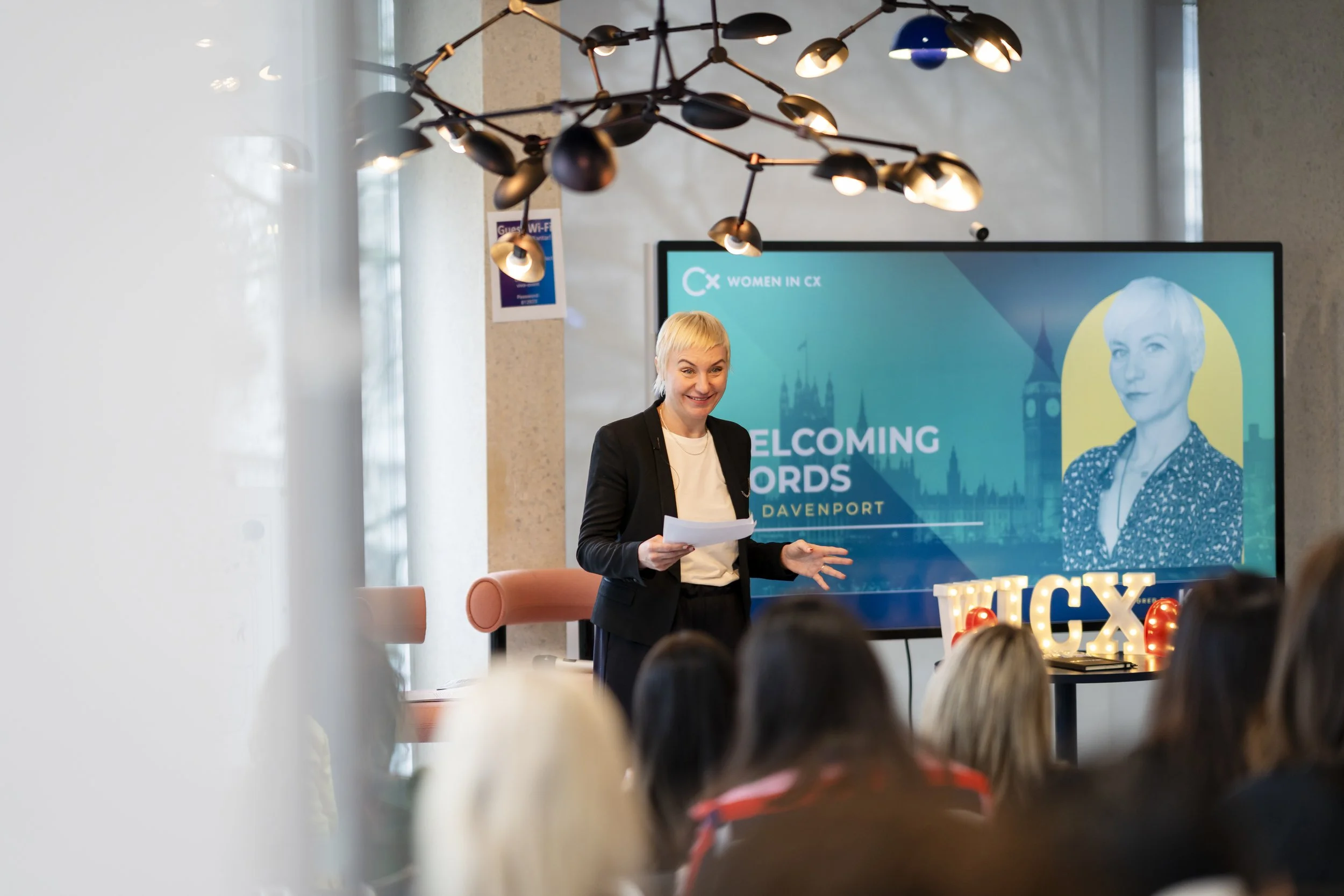
“We often end up acting as the custodians of trust”
Ewa Davenport
Designing Around Human Behaviour
One of the most revealing examples came from Lily McNally, who described research conducted while designing an AI-supported investment experience.
When her team began speaking with customers, they discovered something that had not appeared in any of the strategic planning documents.

Many people were embarrassed to ask basic questions about investing.
They did not want to ask their colleagues. They did not want to ask friends. Some avoided financial advisors because they felt they should already understand the fundamentals.
That insight changed how the team approached the design problem. Instead of focusing purely on efficiency, they began designing around emotional safety.
As Lily explained, the principles guiding the experience became “emotional safety, clarity and trust,” recognising that customers need to feel comfortable before they will engage with financial tools at all.
It was a reminder that many of the most important design decisions around AI have little to do with the technology itself.
They begin with understanding human behaviour.
Where CX Enters the Conversation
Another theme that surfaced during the discussion was where CX teams typically enter AI initiatives.
In many organisations those initiatives still begin inside product or technology teams, with CX invited in once the solution has already been defined.
Sandrea Morgan described the consequences of that sequence.
“If CX isn’t involved in the design, the outcomes aren’t very good,”
When CX teams are involved earlier — during research, design and testing — the role AI plays in the experience tends to become clearer. Automation can remove friction from routine interactions, leaving teams more space to focus on complex customer needs.
“You (CX) own your service,” Sandrea said. “You know how customers interact with your brand.”
That perspective places CX leaders in a position to guide where automation strengthens the experience and where it risks weakening it.

“If CX isn’t involved in the design, the outcomes aren’t very good”
Sandrea Morgan
Organisational Structure and Customer Journeys
Helen Shaffer introduced another dimension to the conversation: the way organisations themselves are structured.
Most companies are still organised around internal teams owning different parts of the customer journey. One team manages login. Another owns checkout. Another owns support.
Customers experience those systems very differently.
“The customer experiences everything all at once,” Helen said, while internally organisations are often “broken up into a million different pieces.”
When AI is introduced into that environment without redesigning the underlying experience, the technology can reinforce existing problems.
“If we automate within the system that already exists,” Helen explained, “we’re just going to amplify” those issues.
Responsible AI therefore requires more than introducing new tools. It requires organisations to rethink how experiences are designed across teams.

“If we automate within the system that already exists, we’re just going to amplify [those issues]”
Helen Shaffer
Trust as the Real Metric
Another point that returned repeatedly during the discussion was the role trust now plays in AI adoption.
Customers are increasingly aware that organisations are introducing AI into their experiences, but their assumptions about why that is happening are not always positive.
Ewa Davenport shared research suggesting that around one-third of consumers currently believe brands are using AI primarily to increase profit.
Once that perception forms, automated interactions can quickly become harder for customers to trust.
But when AI is introduced in ways that clearly support customers or employees, the relationship can move in the opposite direction.
However, while there’s some scepticism – there always is when new tools and platforms are introduced
But there is great opportunity for brands to leverage AI to deliver cues of trustworthiness and build a lot of positive sentiment
In turn, consumers' willingness to trust grows, and adoption follows. And, commercial performance tends to follow.
Trust, in other words, is not simply an ethical concern. It is a commercial one.
The Leadership Decision
What the discussion at the CX Lab made clear is that AI in customer experience is no longer simply a question of technology.
It is becoming a question of leadership.
Most organisations are still early in their understanding of how AI will reshape customer interactions. The systems are improving quickly, but the organisational structures, governance and design practices around them are still evolving. That means the decisions being made now will have an outsized influence on how customers experience these technologies in the years ahead.
Where automation is introduced. Where human support remains essential. Where trust must take priority over efficiency.
These are not purely technical decisions. They are judgements about the kind of relationships organisations want to build with their customers.
The leaders shaping customer experience today are therefore doing more than implementing new tools. They are setting the conditions for how intelligent systems will operate inside the everyday lives of customers and employees.
Handled well, AI has the potential to remove friction, expand access to services and allow employees to focus on the moments where human judgement matters most.
Handled poorly, it risks introducing distance into experiences that depend on understanding, empathy and trust.
The technology itself will continue to evolve quickly. What will matter just as much is the judgement applied to how it is used.
Because ultimately, the future of customer experience will not be defined by how sophisticated AI becomes. It will be defined by how carefully organisations decide where it belongs — and how thoughtfully leaders choose to design the experiences that surround it.
Stay Connected with Women in CX
This conversation took place during the first 2026 Women in CX International Women’s Day CX Lab, hosted at Kantar’s London HQ.
The CX Lab series was created to offer something different from traditional panels or networking events — a space for women working across CX, insight, design and technology to step out of delivery mode and explore the leadership questions shaping the future of customer experience.
A huge thank you to Kantar for hosting the event and helping bring together such an insightful group of practitioners and leaders.
Women in CX hosts conversations like this throughout the year, alongside working sessions, webinars and community discussions designed to support women shaping customer experience across industries.
If you’d like to stay connected with upcoming events, research and conversations from the community, you can join the Women in CX community.