
Why Customer Insight Still Fails to Become Action
Organisations know more about their customers than ever before. Turning that knowledge into change depends on how leaders set priorities, allocate investment and build commitment around the problems that matter.
By Clare Muscutt, Founder and CEO, Women in CX
Customer problems rarely remain unresolved because nobody has noticed them.
The evidence is usually already there: in calls, complaints, journey maps, behavioural data, frontline knowledge and research. AI can now analyse millions of interactions, identify patterns and surface emerging issues at a speed that would have been impossible a few years ago. Yet customers still encounter the same failures year after year.
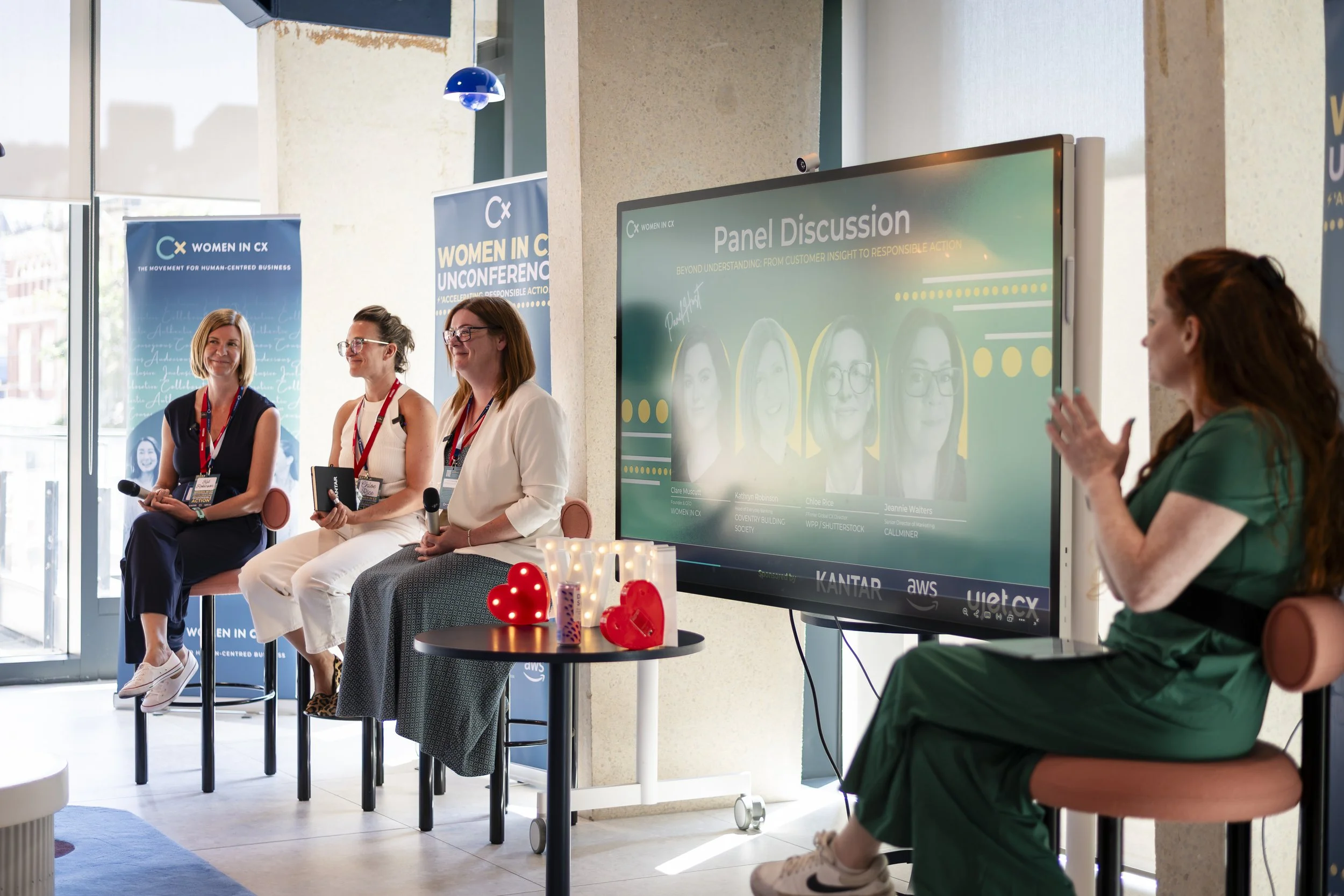
That contradiction opened our first panel at the Women in CX EMEA UnConference 2026 in London. I was joined by Kat Robinson, Head of Everyday Banking at Coventry Building Society; Chloe Rice, former Global CX Director at Shutterstock; and Alex Robson, Senior Director at CallMiner.
We began with a question: what is one customer problem organisations already understand but still are not acting on?
The answers moved the conversation away from any supposed shortage of insight. Difficult cancellation journeys persist because they may protect short-term revenue or require substantial work to redesign. Banks know that products and permissions designed around conventional households no longer reflect the realities of blended families, intergenerational care and longer lives. The need is visible, but solving it cuts across legacy data, access permissions, financial crime controls and organisational boundaries.
These examples expose the real gap. Insight does not enter a neutral system in which the clearest customer problem automatically receives attention. It enters an organisation already shaped by strategic commitments, functional targets, risk obligations, constrained budgets and unequal influence.
The work of turning insight into action begins there.
Known problems can remain rationally unresolved
The phrase ‘insight-to-action gap’ can make inaction sound like a broken handover: researchers find something, leaders fail to understand it and delivery stalls. The panel described a more difficult reality.
Every organisation knows about more customer problems than it can afford to solve. Some are inconvenient. Others demand changes to systems, policies and ownership structures that have accumulated over decades. Even an apparently simple improvement may affect revenue assumptions, regulatory controls or several functions with different priorities.
At Shutterstock, customers had long struggled to cancel. The company knew the journey was difficult, but redesigning it required a significant programme of work. When Chloe’s team eventually introduced self-service cancellation flows, the feared commercial damage did not materialise. Easier, more transparent cancellation contributed to better retention.
The lesson is broader than cancellation. Organisations often preserve friction because they have treated its commercial effect as self-evident. The customer evidence has to challenge that assumption in terms the business is prepared to test.
Kat’s example from retail banking showed another reason problems persist: the need may be clear while the route to solving it is structurally complex. Modern families do not always fit the one-person, one-account model around which many banking systems and controls were designed. Customers caring for an older relative often construct informal workarounds because formal permissions do not support what they need to do. Banks are aware of the problem, but any response has to navigate dispersed data, privacy, authority and financial-crime risk.
Inaction in these cases is not explained by a lack of empathy or information. The problem has not yet secured sufficient priority, ownership and investment relative to the difficulty of changing it.
Customer priorities need a route into funded work
Kat described the path from insight as moving from ‘what’ to ‘so what’ and then ‘now what’. Many organisations stop after describing the problem, or allow too much distance to open between those stages. The people who could turn the evidence into a decision are often absent.
Her most practical point concerned how CX leaders work with the organisation that exists. Customer priorities do not always need to wait for a programme carrying a CX label. They can be advanced through funded work already connected to growth, risk or transformation.
At the Co-operative Bank, for example, an onboarding journey needed major change because it created financial-crime risk. Once that work had funding and executive attention, it also created an opportunity to improve the journey for customers. A growth objective can create the same opening: if a bank wants to increase market share, the ease with which people can open and use an account becomes part of delivering that strategy.
This is sometimes dismissed as organisational politics. That misses the point. Strategy is how organisations decide which outcomes receive money and authority. CX leaders who understand those decisions can connect customer problems to work the business is already committed to delivering. They can also influence the next planning cycle so that more customer outcomes are represented explicitly.
The risk is allowing customer value to become a decorative justification for a decision already made. Alex drew a clear distinction between searching for customer evidence to support an internal objective and listening for what customers are actually struggling with. Both directions matter. Leaders need to use strategic priorities as a route to action without filtering out evidence that challenges those priorities.

Kat’s most practical point: CX leaders work with the organisation that exists. Customer priorities do not always need to wait for a programme carrying a CX label. They can be advanced through funded work already connected to growth, risk or transformation.
Evidence must be designed to support a decision
Dashboards make customer information visible, but visibility is not the same as consequence. Once a metric becomes the target, teams can concentrate on shifting the number while leaving the underlying experience intact.
Chloe’s experience at Shutterstock showed what a more useful evidence chain looks like.
When she established the CX team, the company had been collecting several sources of customer data for years, including NPS, but much of it was not being used. An audit revealed that declining NPS appeared alongside falling customer retention in the ecommerce business. Feedback also showed that customers felt they were constantly being sold to. New customers received promotional emails, but little practical help with using the platform or deciding whether it was right for them.
The team did not begin with a large transformation proposal. It introduced a weekly series of recorded customer webinars and tracked platform usage before and after customers engaged with them. Usage increased. Modelled across a twelve-month period, the programme was associated with $1.2 million in additional usage. Marketing then incorporated the recordings into onboarding and the knowledge base.
The intervention was deliberately ‘rough and ready’, in Chloe’s words. Its value came from creating a measurable connection between a customer need, a change in behaviour and a commercial outcome quickly enough to build confidence.
Her team also added a feedback mechanism to Salesforce for enterprise customers. Feedback submitted by sales teams could then be viewed alongside account tenure, historic spend, opportunity data and potential revenue before being passed to product. A comment that looked minor in isolation could carry very different significance once attached to the customer and commercial context around it.
This is the distinction between evidence that reports and evidence that helps someone choose. A useful case for action explains the problem, who it affects, what will happen if it continues, which organisational outcome it influences and what can be tested next.
AI can widen the field of view, but it cannot assign responsibility
The panel did not treat AI as a solution to the insight-to-action gap. Alex was explicit: AI is technology; people still have to make and carry out the decision.
Its contribution can nevertheless be substantial. Most organisations review only a small sample of customer conversations and the minority of customers who complete surveys or make formal complaints. AI allows teams to analyse far more interactions, categorise them consistently and detect issues they were not actively searching for.
That matters because complaint volume is a poor proxy for importance. Customers do not complain about every failure. Some abandon the task, accept the inconvenience or find their own workaround. When a problem represents only a small proportion of contacts, leaders may dismiss it until the volume becomes impossible to ignore. By then, the organisation is responding to damage rather than preventing it.
Used carefully, customer intelligence can connect conversational, operational and financial data; identify a pattern early; and model how it could develop. It can place relevant guidance in front of an employee during a live interaction, recommend the next best action or trigger a workflow. It can also help construct the fuller story required to engage the people who control the affected process.
None of this decides whether the problem deserves action. Models reflect what has happened before and predictions carry uncertainty. Nor can a platform determine who should be accountable when ownership crosses functions. Technology can strengthen the evidence and shorten the distance between a signal and a response. Leaders still have to judge the trade-offs, assign responsibility and decide what they are prepared to change.

Alex was explicit: AI is technology; people still have to make and carry out the decision. AI is not a solution to the insight-to-action gap.
Commitment is built before the executive meeting
Even strong evidence can fail when CX leaders treat the executive meeting as the place where commitment will be created.
Kat argued that the formal meeting should be almost boring because the important work has already happened. That work includes understanding each leader’s priorities, testing the argument with them or someone who knows them, surfacing objections and adapting the case before the collective decision. Without it, a CX leader may have a few minutes to address several executives who define value differently.
This is not an exercise in telling every stakeholder whatever they want to hear. It is a way of establishing what each person needs to support a decision and where genuine disagreement remains. The CFO may need a credible account of cost and value. An operations leader may need to understand execution and capacity. A risk leader will want to know what exposure the proposal reduces or creates. The customer problem remains the same, but the responsibilities around the table differ.
Chloe also stressed the importance of organisational visibility. Her team had an executive sponsor in the CMO and secured space in company-wide meetings to share its work, results and challenges. That repeated exposure helped colleagues understand what the CX team was doing before it needed their support for a specific programme.
Stakeholder work is often treated as an adjunct to the analytical or design work. In practice, it is one of the central capabilities of CX leadership. If no one has the time and responsibility to build these relationships, insight will continue to arrive at decision points without the coalition required to act on it.
Responsible action requires an explicit choice
More data will not remove the need to prioritise. Better technology may increase the number of problems an organisation can see without increasing its capacity to solve them.
Responsible action therefore begins with an honest choice: which customer problem warrants attention now, based on its human impact, commercial consequence, strategic relevance, risk and the cost of delay? It also requires clarity about which problems are being deferred and why.
That is a more demanding standard than being ‘customer-led’ in principle. It asks leaders to show how customer evidence changed a decision, redirected investment or altered the design of work already under way. It asks CX teams to move beyond producing understanding and become more capable at shaping priorities, constructing evidence and building commitment across functions.
The panel’s examples also challenge the assumption that customer and commercial outcomes sit on opposite sides of every decision. Easier cancellation improved retention. Useful onboarding increased usage. Risk remediation created an opportunity to redesign a poor journey. These outcomes became compatible because someone did the work to connect them and then measured what happened.
Organisations do not need another promise that insight will automatically create action. They need better mechanisms for deciding what matters and clearer accountability for what happens next.
That is where responsible action starts.
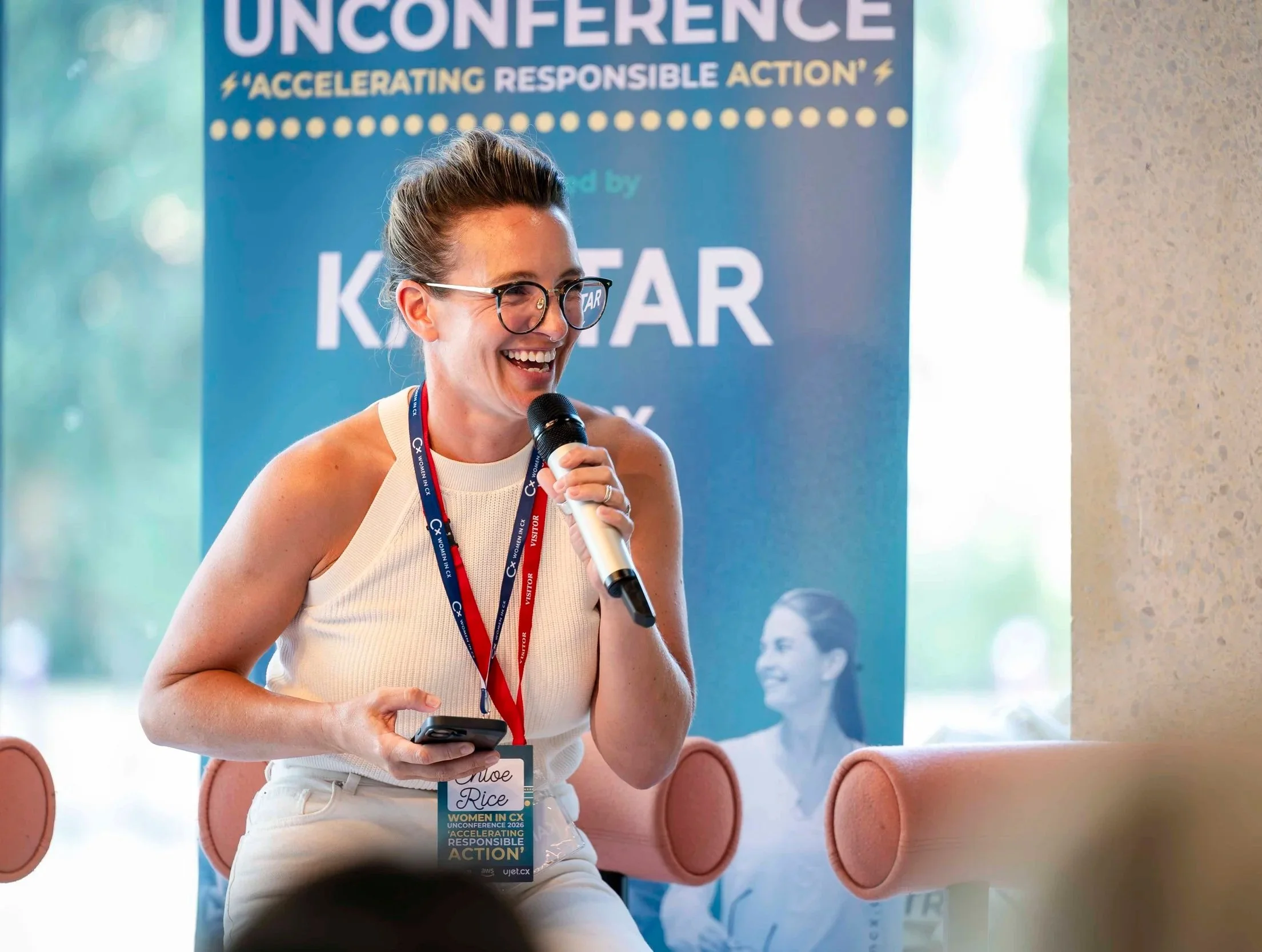
Chloe stressed the importance of organisational visibility. Her team had an executive sponsor in the CMO and secured space in company-wide meetings to share its work, results and challenges. That repeated exposure helped colleagues understand what the CX team was doing before it needed their support for a specific programme.
Continue the conversation in Dallas
Women in CX UnConferences have already brought women together in Berlin, Miami and London to examine the decisions shaping the future of customer experience — and turn those conversations into practical, community-authored work.
On 20–21 October 2026, we bring the UnConference to Dallas.
We’ll be taking these questions further with women working across customer experience, insight, design, operations, transformation, technology and AI.
And the women in the room won't simply be listening to the conversation.
They'll be contributing their own experience and challenges, working together through our collaborative intelligence workshops and helping us co-author the next WiCX UnConference Playbook.
Applications are now open, and every application is personally reviewed by our Founder & CEO, Clare Muscutt, as we curate the mix of experience and perspectives in the room.
Could you be one of them?
Explore the agenda and apply to attend the Women in CX US UnConference Dallas.