
‘AI Voice Agents Are Not a Contact Center Tool – They’re an Operating Model Decision’ by Stacy Dye
As AI rapidly reshapes the CX landscape, many organisations are exploring how voice agents can support their contact center operations. But beyond efficiency gains and automation targets, a bigger strategic question is emerging: how should AI reshape the way customers engage with us in the first place?
In this thought-provoking piece, Stacy Dye, Sr. Director, Success Strategy at CallMiner, challenges us to look beyond AI as a tactical solution. She reframes AI voice agents as an operating model decision – one that can influence when, where, and why customer conversations happen at all.
Through this lens, Stacy explores how organisations can move from reactive service to preventative engagement, and why reducing the need for customer contact can be more powerful than simply handling it faster. Her perspective is a timely reminder that the future of CX isn’t just about smarter tools, but about smarter experience design.
Most organizations are deploying AI voice agents with a narrow objective: reduce contact center costs by automating inbound calls.
That approach captures some value, but it misses the strategic opportunity.
AI voice agents, combined with conversation intelligence, do far more than automate existing conversations. Properly deployed, they change which conversations happen at all, when they happen, and where they occur. They fundamentally shift customer engagement upstream, often eliminating the need for inbound contact altogether.
For executives, this is not a technology question. It’s a demand, risk, and experience design question.
To understand the real shift underway, it helps to look at two closely related ideas:
AI voice agents enable conversations that were previously impossible or impractical
AI allows customer engagement to move outside the traditional contact center
The Limits of the Traditional Contact Center Model
Contact centers are inherently reactive. Conversations only occur if:
A customer encounters friction, confusion, or failure
The customer decides to initiate contact
The expected value of the interaction justifies the cost
Inbound volume, therefore, is not a neutral workload metric—it’s feedback. It is a lagging indicator of upstream breakdowns across product design, communication, operations, and policy. Additionally, countless potentially valuable conversations never happen.
Historically, companies have accepted this model because the alternatives—proactive, continuous engagement—were too expensive and too complex to scale with human labour.
That constraint no longer exists.
“Inbound volume...is a lagging indicator of upstream breakdowns across product design, communication, operations, and policy”
AI Voice Agents Enable Conversations That Were Never Economical Before
AI fundamentally changes the economics of customer interaction:
Near-zero marginal cost per conversation
Always-on availability
Consistent execution at enterprise scale
This makes it viable to engage customers in ways that were previously impractical or unjustifiable, including:
Proactive outreach when anomalies or risks are detected (before customers experience a problem)
Preemptive explanations before customers become confused (micro-engagements such as confirmations, reminders, or explanations)
Timely confirmations and clarifications that reduce anxiety (through behavior or event driven outreaches)
Engagement in any language, independent of agent staffing constraints
These are not automated versions of existing calls. They are net-new conversations that materially reduce downstream demand, churn risk, and brand damage. This approach will fundamentally change the customer experience.
From an executive perspective, the true value extends beyond cost savings. It lies in preventing risk, preserving trust, and creating frictionless experiences that strengthen customer relationships.
Shifting Engagement Outside the Contact Center
Instead of waiting for customers to reach out, organizations can engage earlier in the journey, embedding support where friction actually occurs.
This shifts engagement from:
Centralized to distributed
Reactive to preventive
Episodic to continuous
When AI voice agents are deployed proactively and contextually, support is no longer something customers “reach out for.” It becomes something embedded into:
Moments of change
Points of uncertainty
High-risk transitions
Behavioural signals indicating friction
As a result, many traditional inbound calls simply never occur. This is not deflection. It is demand elimination.
Three mechanisms drive this shift:
Proactive communication that removes uncertainty before it becomes a problem
True self-service that resolves issues end-to-end, not just reroutes them
In-journey assistance that appears precisely where friction emerges
The cumulative effect is a material reduction in inbound demand, not because customers are blocked, but because they no longer need to ask.
From Reactive to Preventative: The Intelligent CX Automation Journey
Most AI voice agent deployments, as part of larger automation programs, focus on speed and volume, reducing handle time and increasing containment. Those gains matter, but they are fundamentally reactive. They optimize the response to customer problems rather than getting ahead of or eliminating the problems themselves.
Preventative engagement requires a different operating mindset. That’s where the concept of intelligent automation comes in. By continuously learning from the signals customers provide across every channel of interaction, organizations can not only better understand how, where, and when to automate interactions – such as through AI voice agents – but they can also prioritize precision, prevention, and trust.
This shift depends on a deep understanding of why customers contact you. AI-driven classification and journey analytics reveal the real drivers of demand, not just the surface-level topics, making it possible to identify the friction points, misunderstandings, and failure modes that repeatedly push customers into the contact center.
These customer signals shouldn’t be contained within the contact center operational silo. Intelligence must move horizontally, informing product, marketing, billing, and compliance. Prevention becomes possible when upstream teams anticipate and fix the conditions that generate downstream support demand.
Organizations typically progress through four stages as they move from reactive automation to preventative engagement:
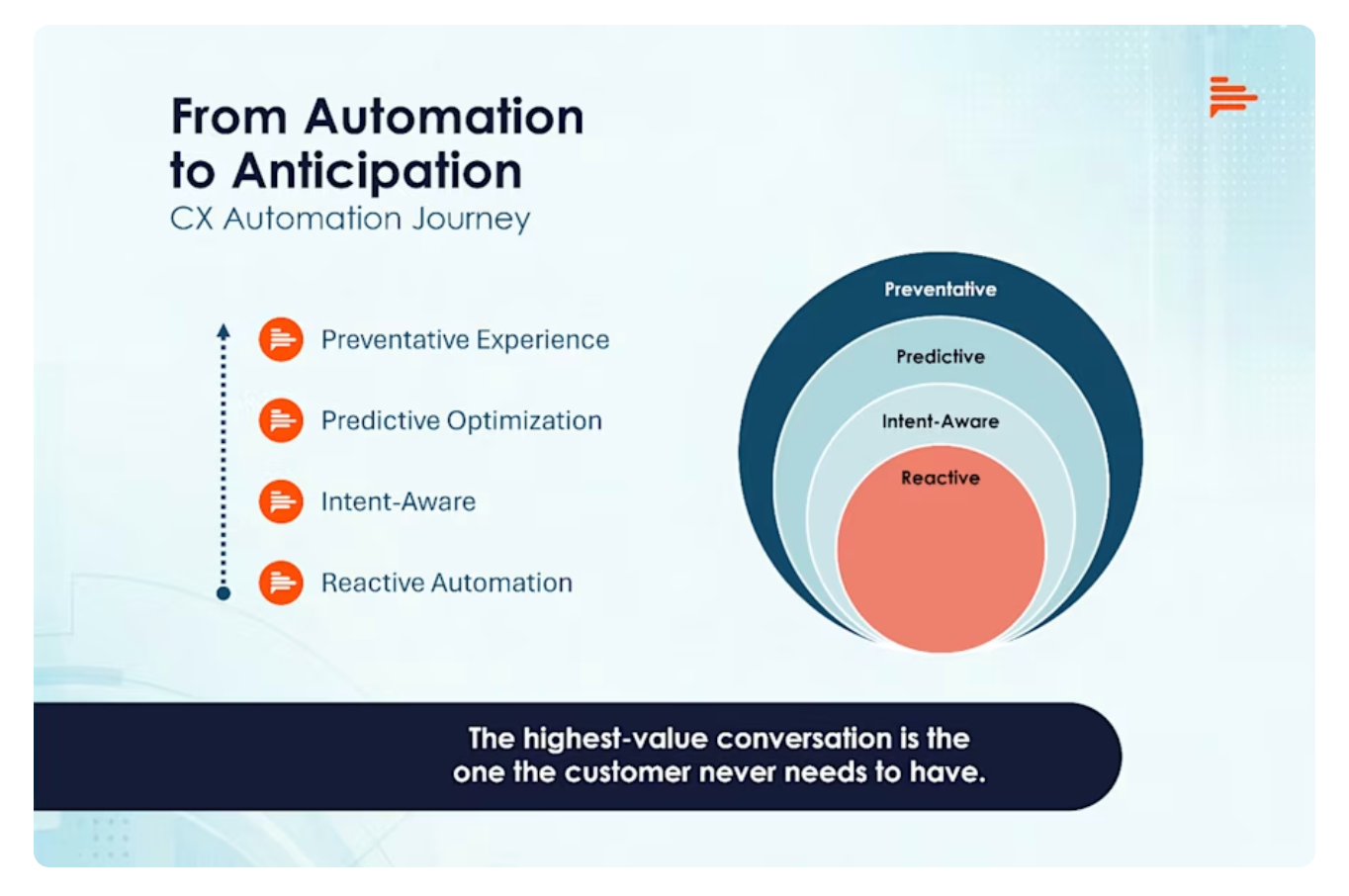
Stage 1 — Reactive: Automating what is already happening
Self-service resolves simple, well-defined issues after customers seek help.
Example: A billing dispute is handled through automated self-service.
Stage 2 — Intent-aware: Understanding the “why” behind inbound contact
Systems detect intent, emotion, frustration, churn risk, or compliance exposure and route accordingly.
Example: High-friction interactions are escalated to specialized agents.
Stage 3 — Predictive: Anticipating needs from patterns, scoring, and historical behavior
The organization identifies which customers are likely to escalate and intervenes before the call.
Example: Proactive outreach offers resolution options before disputes arise.
Stage 4 — Preventative: Eliminating the need for inbound contact entirely
Product, communication, and policy changes address root causes so that customers never encounter the issue.
Example: Billing accuracy and clarity improve to the point that disputes disappear.
A Practical Industry Example
Consider a utility or telecom provider.
Inbound call spikes are often driven by usage anomalies, billing changes, or service disruptions; situations where customers are uncertain rather than broken.
With intelligent automation and AI voice agents, the organization can:
Proactively notify customers of abnormal usage and explain why
Communicate service disruptions before customers seek updates
Resolve billing questions immediately through conversational self-service
The economic impact is not limited to call avoidance. It includes reduced churn, fewer escalations, and improved customer trust during moments of stress.
What This Means For Executive Leaders
When engagement moves upstream, the role of the contact center evolves.
Human agents become the critical layer for situations that require human judgment, nuanced problem solving, and personalised relationship building - but also play an active role in training and refining AI systems, contributing to continuous improvement of automation, and ensuring customer interactions align with brand values. They remain central to employee health and wellbeing, serving as a bridge between technology and the people delivering service.
AI handles prevention, scale, and timing, while humans ensure the system learns, adapts, and stays customer-centric.
This shift requires new success metrics:
From cost per call to cost of preventable demand
From handle time to issues avoided
From efficiency to journey integrity and human-AI collaboration quality
It also expands ownership beyond the contact center. Product, digital, operations, and risk leaders - together with human agents - influence how and if customers need to engage at all, and how AI evolves to meet those needs sustainably.
The Future of Customer Engagement
The next generation of customer engagement must focus on this concept: “The highest-value conversation is the one the customer never needs to have.”
The leaders and organizations that treat AI voice agents as contact center automation and engagement infrastructure will not just optimize yesterday’s operating model – they'll redesign how customers experience the business, reducing demand, mitigating risk, and building trust at scale.
What is an AI Voice Agent?
An AI voice agent can:
Hear spoken language (speech-to-text)
Understand intent and context (natural language understanding + reasoning)
Respond out loud in a natural voice (text-to-speech)
Hold a conversation, not just follow a script
It doesn’t just recognize keywords — it understands what the person is trying to do.