
Responsible CX by Design: What Are We Teaching Our Systems to Optimise For?
Key takeaways from Clare Muscutt’s keynote on building trust in the age of AI.
A customer cannot access their account. The authentication system requires a code sent to a phone number they no longer use. The automated telephone service directs them back to the online account they cannot open. Each process follows its rules. The customer remains locked out.
For Clare Muscutt, Founder and CEO of Women in CX, this is a revealing example of how organisations produce poor experiences through decisions that can appear entirely reasonable when considered separately.
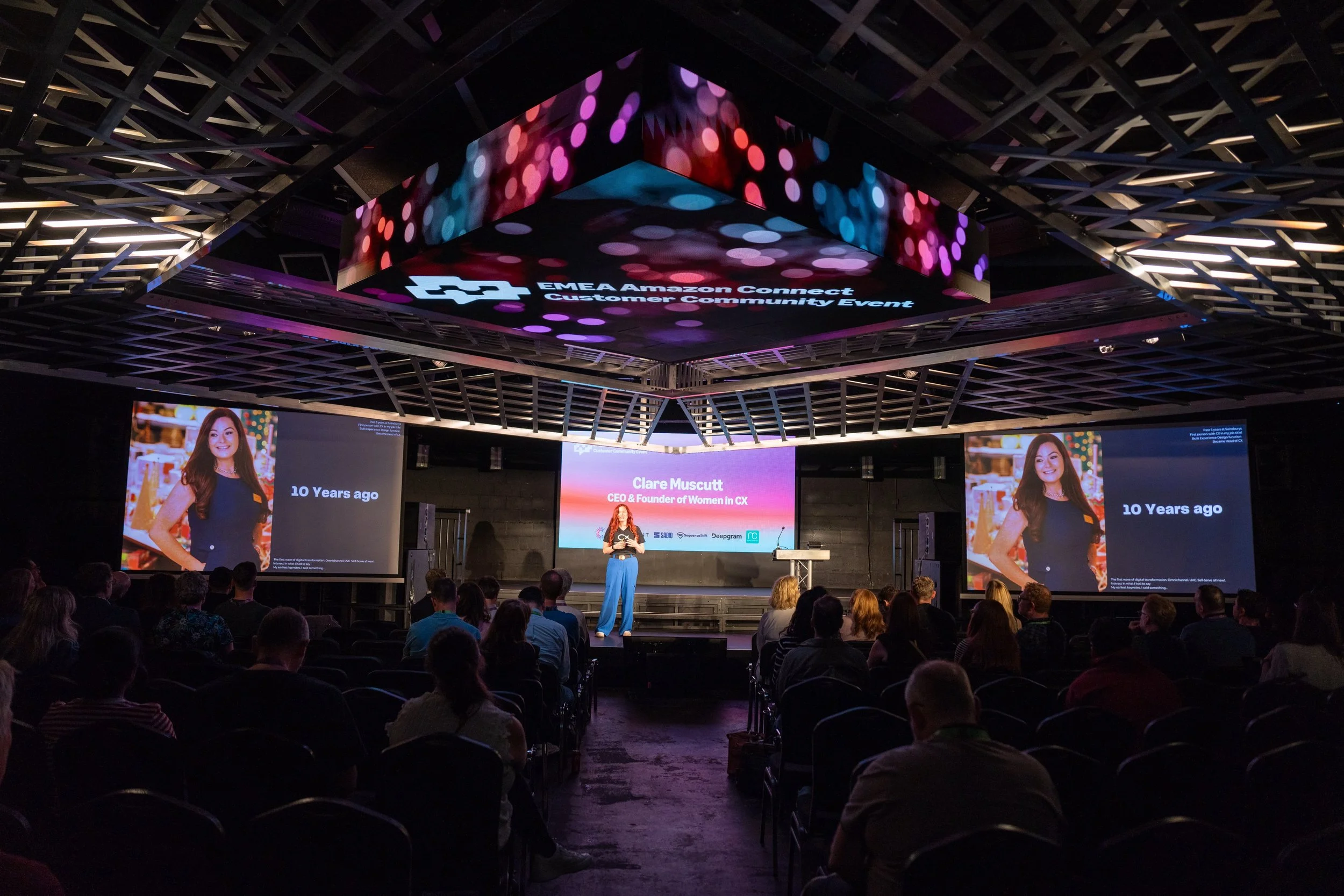
In a presentation originally delivered as a closing keynote for Amazon Web Services customers and technology leaders at the Ministry of Sound in London, Clare examined what happens when organisations optimise for internal targets without deliberately designing the outcomes customers need. As AI gains authority to make decisions and take action, she argued, those choices require much closer scrutiny.
Her central question: what are we teaching our systems to optimise for?
1. Customer experience is an organisational outcome
Customers encounter the consequences of decisions made throughout a business. A policy determines whether they qualify for help. A performance target influences how much time an employee can spend with them. A technology decision determines whether their circumstances fit the available options.
Together, those choices create the experience.
Clare’s argument challenges the assumption that a CX team can improve that experience while the systems producing it remain unchanged. A team may understand the problem, map the journey and collect feedback, yet lack the authority to change the policy or incentive responsible for the failure.
What an organisation chooses to optimise for shapes what it measures, funds and rewards. When cost reduction, productivity and channel containment dominate those choices, customer outcomes (and experiences) can become an accidental byproduct.
Those operational measures have legitimate uses. The problem arises when organisations treat them as sufficient evidence of success. For example, containment. A customer who stops calling may have resolved their issue. They may also have given up.
Responsible CX by Design requires leaders to define the outcome they intend to create for the customer and make it part of the organisation’s decisions about performance.
2. Design must account for what happens when life disrupts the process
Clare illustrated the consequences of narrow system assumptions through her own experience of losing access to business services.
After changing her phone number and cancelling an unused domain, she encountered authentication and recovery processes that depended on contact details she could no longer access. HMRC’s automated telephone system repeatedly directed her towards the online portal she was locked out of. Restoring access eventually required a paper form. With Dropbox, she described being unable to cancel an account without access to the original email address, eventually blocking payments through her bank.
The immediate issue was account access. The wider design failure was the absence of a workable route through changed circumstances.
People lose phones, change names, forget passwords, become ill and experience disruption. Some need support that a standard process has never accommodated. Treating these circumstances as peripheral leaves customers carrying the work of bridging gaps between systems.
Inclusive design brings those conditions into the design process. It asks whose circumstances the service assumes, who struggles under those assumptions, and how someone can recover when the expected sequence breaks down.
Security remains essential. So does a recovery route that allows a legitimate customer to regain access without being sent around the same loop.

“Responsible CX by Design requires leaders to define the outcome they intend to create for the customer and make it part of the organisation’s decisions about performance.” — Clare Muscutt
3. Start with the customer’s mission
A second personal example showed what becomes possible when digital services support the outcome a customer needs.
After her cards were stolen during a journey across the Andes in South America, Clare found herself at a Chilean bus station without cash or mobile data. Using a stranger’s hotspot, she accessed her Barclays banking app, reported the theft and obtained digital replacement cards she could use through Apple Wallet.
The service task was replacing a card. Her immediate mission was to regain safe access to money so she could continue her journey.
Understanding that mission changes the design brief. It directs attention towards whether the customer can use their money now, rather than simply whether a replacement request has been processed.
In this instance, Clare could act through self-service without calling for assistance. The example shows how meeting a customer’s needs can also reduce demand for support. It does not remove every tension between cost and customer outcomes, but it gives leaders a reason to examine whether some apparent trade-offs arise from the way the service has been designed.
Clare’s Mission Test offers a practical starting point: identify what the person is trying to achieve beyond completing the organisation’s process. Then ask whether the proposed solution enables that outcome, including when circumstances are difficult.
4. AI brings customer experience into decision design
Employees often compensate for the limitations of organisational systems. They notice when a rule produces an unreasonable result, interpret information the process has missed, or find someone with the authority to help.
As organisations delegate more decisions to AI, they need to decide deliberately how those capabilities will be preserved.
The implications extend beyond the quality of a chatbot’s answers. Systems may influence or determine access to services, prioritise cases, assess eligibility, resolve disputes or decide when to escalate. Those decisions shape what customers can do and what happens to them.
For CX leaders, this expands the work into the objectives, permissions and constraints governing automated decisions. Journey understanding helps reveal where those decisions matter and whose needs may be overlooked.
An organisation that rewards an AI system primarily for reducing escalation must examine what happens to people whose problems require intervention. A falling escalation rate provides an incomplete picture if customers are left without a resolution.
Responsible decision design therefore needs named accountability, clear limits on delegated authority and accessible routes to human review. It also requires monitoring that can reveal who is being poorly served, including customers who abandon the process without making a complaint.
AI increases the scale and speed at which organisational choices take effect. That makes the quality of those choices a leadership responsibility long before deployment.

“Responsible decision design therefore needs named accountability, clear limits on delegated authority and accessible routes to human review. It also requires monitoring that can reveal who is being poorly served, including customers who abandon the process without making a complaint.” — Clare Muscutt
5. Connect customer need to the organisation’s ability to deliver
Clare’s Responsible CX by Design framework connects four elements: Customer Need → Brand Promise → Operational Reality → Technology Enablement.
Customer need provides the starting point. Leaders need to understand what people are trying to achieve and the circumstances affecting their ability to do so. Behavioural data contributes to that understanding; research and lived experience help explain what the data leaves uncertain.
The brand promise establishes what customers are being led to expect. Organisations need to examine whether their policies and services can fulfil that expectation, particularly when something goes wrong.
Operational reality determines whether delivery is possible. Ownership, incentives, employee authority and the movement of information between teams all affect the result. A promise to make things easy means little if customers must coordinate disconnected departments themselves.
Technology enables those choices to operate. Its value should be assessed against the customer mission and the business outcomes it supports. Automating an unresolved organisational problem can make that problem harder to escape.
The framework gives leaders a way to examine the connections between these elements before committing to a solution. Where a promise cannot be delivered, the work is to identify what must change in the organisation and who has the authority to change it.
A question to take into the next investment decision
Clare’s presentation places responsibility for customer experience within the decisions that shape how an organisation operates.
For the next AI or transformation proposal, leaders can begin with a specific customer mission and follow it through the proposed system. What counts as success? Who might struggle? What happens when the decision is wrong, and who can put it right?
The answers should influence the investment, its design and the measures used to judge its performance. They belong in the brief before the system is built.
Keep the Conversation Going
Clare’s insights highlight that customer experience is an organisational outcome, shaped by the policies, targets and technology decisions made across a business.
Inside the WiCX Inner Circle, we create spaces for exactly these kinds of conversations.
From expert-led sessions, webinars, and member conversations to live events and industry panels, we bring together women leading the future of CX, AI, and transformation to explore the opportunities and challenges shaping the next era of customer experience.
If you’d like to continue exploring Responsible CX by Design and gain access to more webinars like this one, you can join the WiCX Inner Circle waitlist today.